
Battery Cell Construction Antimony / Calcium / Selenium / Tin Alloying
Battery Application & Technology
The grid structure in both pasted and tubular plate batteries is made from a lead alloy. A pure lead grid structure is not strong enough by itself to stand vertically while supporting the active material. Other metals in small quantities are alloyed with lead for added strength and improved electrical properties. The most commonly alloyed metals are antimony, calcium, tin, and selenium.
The two most common alloys used today to harden the grid are antimony and calcium. Batteries with these types of grids are sometimes called "lead-antimony" and "lead-calcium" batteries. Tin is added to lead-calcium grids to improve cyclability. The major differences between batteries with lead-antimony and lead-calcium grids are as follows:
1. Lead-antimony batteries can be deep cycled more times than lead-calcium batteries.
2. Flooded lead-antimony batteries require more frequent maintenance as they near end-of-life since they use an increasing amount of water and require periodic equalization charges.
3. Lead-calcium batteries have lower self-discharge rates as shown in the illustration below and therefore, will draw less current while on float charge than lead-antimony batteries.
4. Lead-calcium positive plates may grow in length and width because of grid oxidation at the grain boundaries. This oxidation is usually caused by long-term overcharging, which is common to UPS and other batteries on constant-float changing. Grids may grow in size sufficiently to cause buckling or rupture of their containers.
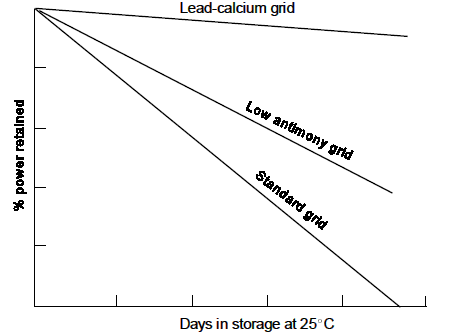
Another type of grid alloy is lead-selenium. In reality, this battery is actually a low lead-antimony grid with a slight amount of selenium. Lead-selenium has characteristics that fall somewhere between lead-calcium and lead-antimony.
When pure lead is mixed with an alloy there may be undesirable characteristics introduced in the performance of the battery. Modern day battery manufacturers try to reduce the amount of antimony and calcium by introducing doping agents such as selenium, cadmium, tin, and arsenic. When batteries containing arsenic and antimony are charged (especially overcharged) the poisonous gases arsine (AsH3) and stibine (SbH3) may be released.
Link to this Webpage:

© Copyright 2000 -
2024, by Engineers Edge, LLC
www.engineersedge.com
All rights reserved
Disclaimer |
Feedback
Advertising
| Contact


