
Specific Gravity of Battery Electrolyte Review
Battery Application & Technology
Specific Gravity of Battery Electrolyte Review
One of the key parameters of battery operation is the specific gravity of the electrolyte. Specific gravity is the ratio of the weight of a solution to the weight of an equal volume of water at a specified temperature. Specific gravity is used as an indicator of the state of charge of a cell or battery. However, specific gravity measurements cannot determine a battery's capacity. During discharge, the specific gravity decreases linearly with the ampere-hours discharged as indicated in the illustration below.
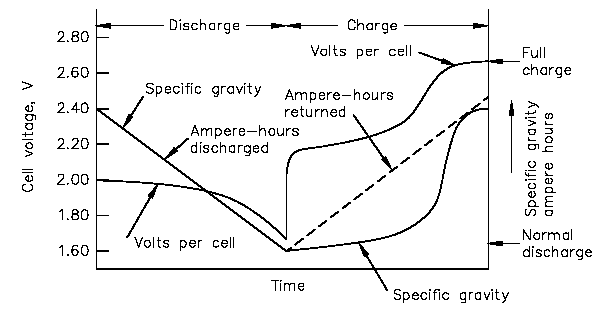
Changes in voltage and specific gravity during charge and discharge
Therefore, during fully charged steady-state operation and on discharge, measurement of the specific gravity of the electrolyte provides an approximate indication of the state of charge of the cell. The downward sloping line for the specific gravity during discharge is approximated by the equation below:
Specific gravity = cell open-circuit voltage - 0.845
or
Cell open circuit voltage = specific gravity + 0.845.
The above equations permit electrical monitoring of approximate specific gravity on an occasional basis. As mentioned earlier, specific gravity measurements cannot be taken on sealed lead-acid batteries. Measurement of the cell open-circuit voltage has been used as an indicator of the state of charge of a sealed battery. More reliable methods for determining the state of charge of sealed batteries are under development.
The specific gravity decreases during the discharging of a battery to a value near that of pure water and it increases during a recharge. The battery is considered fully charged when specific gravity reaches it's highest possible value.
Specific gravity does, of course, vary with temperature and the quantity of electrolyte in a cell. When the electrolyte is near the low-level mark, the specific gravity is higher than nominal and drops as water is added to the cell to bring the electrolyte to the full level. The volume of electrolyte expands as temperature rises and contracts as temperature drops, therefore affecting the density or specific gravity reading. As the volume of electrolyte expands, the readings are lowered and, conversely, specific gravity increases with colder temperatures.
The specific gravity for a given battery is determined by the application it will be used in, taking into account operating temperature and battery life. Typical specific gravities for certain applications are shown in Table 1.

Table 1
In the selection of a battery for a given application, some of the effects of high or low specific gravity to be considered are:
|
Higher Gravity |
Lower Gravity |
|
|
|
| More capacity | Less capacity |
| Shorter life | Longer life |
| Less space required | More space required |
| Higher momentary discharge rates | Lower momentary discharge rates |
| Less adaptable to "floating: operation | More adaptable to "floating" operation |
| More standing loss | Less standing loss |
A solution of higher specific gravity is heavier per unit volume than one of lower specific gravity. Therefore the more concentrated electrolyte created during charging sinks to the bottom of the battery jar creating a gradient in specific gravity. The gassing that occurs on overcharge serves as a "mixer" and makes the specific gravity uniform throughout the cell. To avoid erroneous readings, specific gravity measurements should only be taken after an equalizing charge and subsequent float charge for at least 72 hours.
Link to this Webpage:

© Copyright 2000 -
2024, by Engineers Edge, LLC
www.engineersedge.com
All rights reserved
Disclaimer |
Feedback
Advertising
| Contact


