
Strain Gage Transducer Configurations & Review
Electronics, Instrumentation & Electrical Database
Strain Gage Transducer Configurations & Review
Strain Gage Transducers or elements are available in a wide variety of configurations in both wire and foil gages. Strain gages can take many forms for transducer or stress analysis applications. Strain gages are constructed with many loops of wire material typically made from Constantanl. Constantan resistance is approximately 50 micro-ohms per cm. Strain gages are available in bonded-foil or wire gage packages ranging in length from 0,2 mm to 102 mm. Gage are constructed or fabricated with the resistive wire or foil encapsulated in a thin polyimide film or backing and are encapsulated between two films of polyimide.
Strain gages are bonded to a test piece using a pressure curing cement, such as methyl2-cyanoacrylate. Other adhesives and cements are used as well. The following are typical strain configurations used in industry and research.
Description |
Configuration |
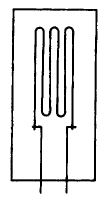
Uniaxial Strain Gage (Wire) Strain Gage |
 |
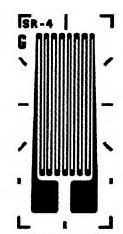
Uniaxial Strain Gage (Foil) Strain Gage |
 |
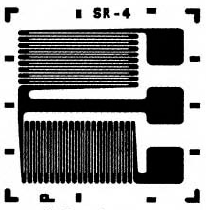
Two-Element 90 Degree Planar Rosette Strain Gage |
 |
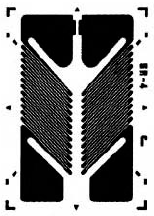
Two-Element, 90 Degree Planar (Shear) Rosette Strain Gage |
 |
Three Element, 60 Degree Delta Rosette strain Gage |
 |
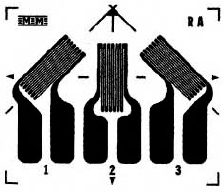
Three Element, 45 Degree Planar Rectangular Rosette Strain Gage |
 |
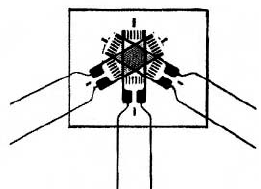
Three Element, 60 Degree Stacked Delta Rosette Strain Gage |
 |
Link to this Webpage:

© Copyright 2000 -
2024, by Engineers Edge, LLC
www.engineersedge.com
All rights reserved
Disclaimer |
Feedback
Advertising
| Contact


