
Thermocouple Operation Basics
Electronics, Instrumentation & Electrical Database
Thermocouple Operation Basics
Thermocouples will cause an electric current to flow in the attached circuit when subjected to changes in temperature. The amount of current that will be produced is dependent on the temperature difference between the measurement and reference junction; the characteristics of the two metals used; and the characteristics of the attached circuit. The illustration below a simple thermocouple circuit.
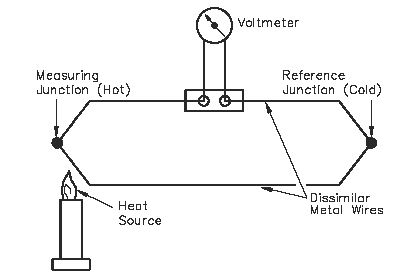
Simple Thermocouple Circuit
Heating the measuring thermocouple produces a voltage which is greater than the voltage across the reference junction. The difference between the two voltages is proportional to the difference in temperature and can be measured on the voltmeter (in millivolts). For ease of operator use, some voltmeters are set up to read out directly in temperature through use of electronic circuity.
Other applications provide only the millivolt readout. In order to convert the millivolt reading to its corresponding temperature, you must refer to tables like the one shown below. These tables can be obtained from the thermocouple manufacturer, and they list the specific temperature corresponding to a series of millivolt readings.
Click on Image below to enlarge
Typical Voltage to Temperature Thermocouple Table

Link to this Webpage:

© Copyright 2000 -
2024, by Engineers Edge, LLC
www.engineersedge.com
All rights reserved
Disclaimer |
Feedback
Advertising
| Contact


