
Centrifugal Pumps Review
Centrifugal Pumps Review
Centrifugal pumps basically consist of a stationary pump casing and an impeller mounted on a rotating shaft. The pump casing provides a pressure boundary for the pump and contains channels to properly direct the suction and discharge flow. The pump casing has suction and discharge penetrations for the main flow path of the pump and normally has small drain and vent fittings to remove gases trapped in the pump casing or to drain the pump casing for maintenance.
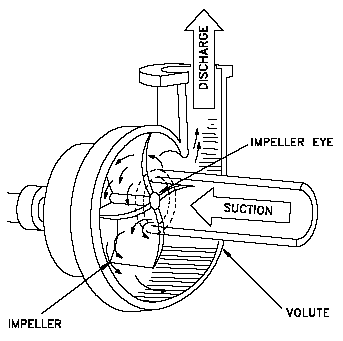
The illustration directly below, is a simplified diagram of a typical centrifugal pump that shows the relative locations of the pump suction, impeller, volute, and discharge. The centrifugal pump casing guides the liquid from the suction connection to the center, or eye, of the impeller. The vanes of the rotating impeller impart a radial and rotary motion to the liquid, forcing it to the outer periphery of the pump casing where it is collected in the outer part of the pump casing called the volute. The volute is a region that expands in cross-sectional area as it wraps around the pump casing. The purpose of the volute is to collect the liquid discharged from the periphery of the impeller at high velocity and gradually cause a reduction in fluid velocity by increasing the flow area. This converts the velocity head to static pressure. The fluid is then discharged from the centrifugal pump through the discharge connection.
Centrifugal pumps can also be constructed in a manner that results in two distinct volutes, each receiving the liquid that is discharged from a 180 degrees region of the impeller at any given time. Pumps of this type are called double volute pumps (they may also be referred to a split volute pumps). In some applications the double volute minimizes radial forces imparted to the shaft and bearings due to imbalances in the pressure around the impeller. A comparison of single and double volute centrifugal pumps is shown below.

Related
- Multi-Stage Centrifugal Pump Multi-Stage Centrifugal Pump Review
- Oil mist Eliminators Review Oil Mist Eliminators trap or filter out oil mist
- Peristalic Pumps Review Peristalic pump uses positive displacement to squeeze a leak-proof tube or hose, forcing the pumped fluid through the hose.
- Piston Pump Review Piston pump is a type of reciprocating pump that pressurizes fluid by using reciprocating pistons
- Plastic Pumps Review Plastic pumps are made for applications which require a high level of corrosion or damage resistance
- Trash Pumps Review Trash pumps, also referred to as sludge pumps, grinder pumps, chopper pumps, or wastewater pumps
- Triplex Pumps Review Triplex pump mechanism contributes to a smooth flow, reduced pressure pulsations, and reduced fatigue
- Cavitation Centrifugal Pump Minimum Safe Suction Head Formulas and Calculator - If the suction pressure of a pump falls to a very low value, the fluid may boil at a low pressure region (e.g. at the vane inlet).
- Centrifugal Pump Components General Typical Centrifugal pumps vary in design and construction from simple pumps with relatively few parts to extremely complicated pumps with hundreds of individual parts.
- Centrifugal Pump Net Positive Suction Head Net positive suction head is the difference between the pressure at the suction of the pump and the saturation pressure for the liquid being pumped.
- Centrifugal Pump Requirements Spreadsheet Calculator
Requires a Premium Membership to download - Preventing Cavitation in Centrifugal Pump System design or operation may be necessary to increase the NPSHA above the NPSHR and stop the cavitation.
- Centrifugal Pump Characteristic Curve Centrifugal Pump Characteristic Curve
- Centrifugal Pump Protection Centrifugal pumps must also be protected from runout.
- Centrifugal Pump Gas Binding Where the pump casing is filled with gases or vapors to the point where the impeller is no longer able to contact enough fluid to function correctly.
Link to this Webpage:

© Copyright 2000 -
2024, by Engineers Edge, LLC
www.engineersedge.com
All rights reserved
Disclaimer |
Feedback
Advertising
| Contact


