
Temperature Scales - Thermodynamics
Thermodynamics Directory | Heat Transfer Directory
Temperature Scales
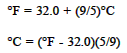
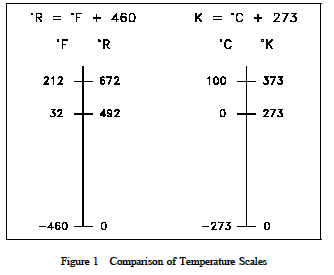
The two temperature scales normally employed for measurement purposes are the Fahrenheit (F)and Celsius (C) scales. These scales are based on a specification of the number of increments between the freezing point and boiling point of water at standard atmospheric pressure. The Celsius scale has 100 units between these points, and the Fahrenheit scale has 180 units. The zero points on the scales are arbitrary.The freezing point of water was selected as the zero point of the Celsius scale. The coldest temperature achievable with a mixture of ice and salt water was selected as the zero point of the Fahrenheit scale. The temperature at which water boils was set at 100 on the Celsius scale and212 on the Fahrenheit scale. The relationship between the scales is represented by the following equations.
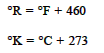
It is necessary to define an absolute temperature scale having only positive values. The absolute temperature scale that corresponds to the Celsius scale is called the Kelvin (K) scale, and the absolute scale that corresponds to the Fahrenheit scale is called the Rankine (R) scale. The zero points on both absolute scales represent the same physical state. This state is where there is no molecular motion of individual atoms. The relationships between the absolute and relative temperature scales are shown in the following equations.
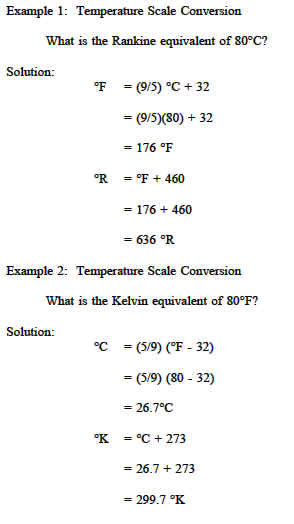
The conversion of one temperature scale to another is sometimes required at nuclear facilities,and the operator should be acquainted with the process. The following two examples will be helpful.
Link to this Webpage:

© Copyright 2000 -
2024, by Engineers Edge, LLC
www.engineersedge.com
All rights reserved
Disclaimer |
Feedback
Advertising
| Contact


