
Reynolds Number Equation and Review
Fluid Flow Table of Contents
Hydraulic and Pneumatic Knowledge
Reynolds Number Equation and Review
The flow regime (either laminar or turbulent) is determined by evaluating the Reynolds number of the flow refer to (Flow Velocity profiles). The Reynolds number, based on studies of Osborn Reynolds, is a dimensionless number comprised of the physical characteristics of the flow. Equation 1 is used to calculate the Reynolds number (NR) for fluid flow.
Eq. 1
N g = ρ v D / ( µ gc )
Where:
N g = Reynolds number (unitless)
v = average velocity (ft/sec)
D = diameter of pipe (ft)
µ = absolute viscosity of fluid (lbf-sec / ft2 )
ρ = fluid mass density (lbm/ft3)
gc = gravitational constant (32.2 ft-lbm / lbf-sec2)
The Reynolds number is defined as the ratio of inertial forces to viscous forces and consequently quantifies the relative importance of these two types of forces for given flow conditions. Reynolds numbers frequently arise when performing scaling of fluid dynamics problems, and as such can be used to determine dynamic similitude between two different cases of fluid flow. They are also used to characterize different flow regimes within a similar fluid, such as laminar or turbulent flow :
- laminar flow occurs at low Reynolds numbers, where viscous forces are dominant, and is characterized by smooth, constant fluid motion;
- turbulent flow occurs at high Reynolds numbers and is dominated by inertial forces, which tend to produce chaotic eddies , vortices and other flow instabilities.
For practical purposes, if the Reynolds number is less than 2000, the flow is laminar. If it is greater than 3500, the flow is turbulent. Flows with Reynolds numbers between 2000 and 3500 are sometimes referred to as transitional flows. Most fluid systems in nuclear facilities operate with turbulent flow. Reynolds numbers can be conveniently determined using a Moody Chart; an example of which is shown in figure B-1. Additional detail on the use of the Moody Chart is provided in subsequent text.
Click on image to view Moody Chart
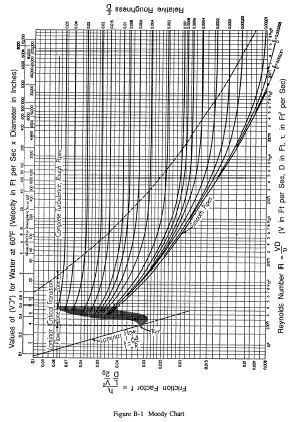
Figure B-1 Moody Chart
Reynolds Number for a Pipe or Duct in Imperial Units
The Reynolds number for a pipe or duct can also be expressed in Imperial units
Re = (7745.8) u d / ν
where
Re = Reynolds Number (non dimensional)
u = Velocity (ft/s)
d = Pipe diameter (in)
ν = Kinematic Viscosity (cSt) (1 cSt = 10 -6 m2/s )
Link to this Webpage:

© Copyright 2000 -
2024, by Engineers Edge, LLC
www.engineersedge.com
All rights reserved
Disclaimer |
Feedback
Advertising
| Contact


