
Log Mean Temperature Difference Application to Heat Exchangers - Heat Transfer
Heat Transfer Engineering
Thermodynamics
In order to solve certain heat exchanger problems, a log mean temperature difference (LMTD or ΔTim must be evaluated before the heat removal from the heat exchanger is determined. The lm following example demonstrates such a calculation.
Example:
A liquid-to-liquid counterflow heat exchanger is used as part of an auxiliary system at a nuclear facility. The heat exchanger is used to heat a cold fluid from 120 deg F to 310 deg F.
Assuming that the hot fluid enters at 500 deg F and leaves at 400 deg F, calculate the LMTD for the exchanger.
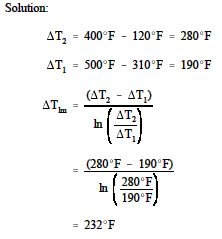
The solution to the heat exchanger problem may be simple enough to be represented by a straight-forward overall balance or may be so detailed as to require integral calculus. A steam generator, for example, can be analyzed by an overall energy balance from the feedwater inlet to the steam outlet in which the amount of heat transferred can be expressed simply as Q = m Δh where is the mass flow rate of the secondary coolant and Δh is the change in enthalpy of the fluid. The same steam generator can also be analyzed by an energy balance on the primary flow stream with the equation Q = m cp ΔT , where , cp , and ΔT are the mass p flow rate, specific heat capacity, and temperature change of the primary coolant. The heat transfer rate of the steam generator can also be determined by comparing the temperatures on the primary and secondary sides with the heat transfer characteristics of the steam generator using the equation Q = Uo Ao Δ Tlm
Condensers are also examples of components found in nuclear facilities where the concept of LMTD is needed to address certain problems. When the steam enters the condenser, it gives up its latent heat of vaporization to the circulating water and changes phase to a liquid. Because condensation is taking place, it is appropriate to term this the latent heat of condensation. After the steam condenses, the saturated liquid will continue to transfer some heat to the circulating water system as it continues to fall to the bottom (hotwell) of the condenser. This continued cooling is called subcooling and is necessary to prevent cavitation in the condensate pumps.
Link to this Webpage:

© Copyright 2000 -
2024, by Engineers Edge, LLC
www.engineersedge.com
All rights reserved
Disclaimer |
Feedback
Advertising
| Contact


