
Commercial Boilers Review
Industrial, Testing, and Engineering Equipment Menu
Commercial Boilers Review
Boilers are pressure vessels used to produce steam or hot water. They are different from furnaces, a term usually used to refer to air heaters of any size. Boilers come in a vast range of types and sizes.
The critical design factor is pressure. Boilers are fitted with safety valves that release the steam or water if the pressure rises significantly above the design pressure. The safety-equipment requirement and staff-monitoring requirements are far less stringent for low-pressure boilers, so there is a significant incentive to use low-pressure except where high pressure is needed, or more economic.
A “low-pressure” steam boiler operates at a pressure of no more than 15 pounds per square inch, 15 psig, more than the local atmospheric pressure. This means 15 psig as measured by a gauge exposed to the local atmospheric pressure. In comparison, “low-pressure” hot water boilers are allowed up to 160 psig. There is a good reason for the extreme difference in allowable pressure:
When a steam boiler fails, the effect can be catastrophic: as the steam expands uncontrollably, it is like a bomb going off. In comparison, when a hot water system bursts, the hot water pours out, but there is no explosive blast like there is with steam. For this reason, “low-pressure” hot water boilers are allowed up to the higher pressure of 160 psig.
Boilers and system components are regulated by codes. These codes are generally written, and updated, by practitioners in their geographic area. The main codes in North America are those issued by the American Society of Mechanical Engineers (ASME) Boiler and Pressure Vessel Code while the European Community has their own, and in many areas, much less demanding set of codes. It is therefore critical that a designer or operator knows the local code requirements, since their experience from one place may not be relevant in another jurisdiction.
Read more ---> Boilers Design and Components
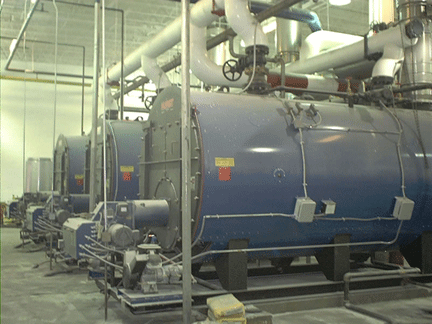
Commercial Boilers
Link to this Webpage:

© Copyright 2000 -
2024, by Engineers Edge, LLC
www.engineersedge.com
All rights reserved
Disclaimer |
Feedback
Advertising
| Contact


