
Bellows Pressure Detector Review
Electronics, Instrumentation & Electrical Database
Bellows Pressure Detector Review
Bellows Pressure Detector provides the need for a pressure sensing element that is extremely sensitive to low pressures and provided power for activating recording and indicating mechanisms resulted in the development of the metallic bellows pressure sensing element. The metallic bellows is most accurate when measuring pressures from 0.5 to 75 psig. However, when used in conjunction with a heavy range spring, some bellows can be used to measure pressures of over 1000 psig. Figure 1 shows a basic metallic bellows pressure sensing element.
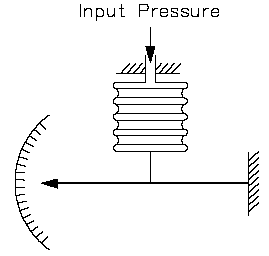
The bellows is a one-piece, collapsible, seamless metallic unit that has deep folds formed from very thin-walled tubing. The diameter of the bellows ranges from 0.5 to 12 in. and may have as many as 24 folds. System pressure is applied to the internal volume of the bellows. As the inlet pressure to the instrument varies, the bellows will expand or contract. The moving end of the bellows is connected to a mechanical linkage assembly. As the bellows and linkage assembly moves, either an electrical signal is generated or a direct pressure indication is provided. The flexibility of a metallic bellows is similar in character to that of a helical, coiled compression spring. Up to the elastic limit of the bellows, the relation between increments of load and deflection is linear. However, this relationship exists only when the bellows is under compression. It is necessary to construct the bellows such that all of the travel occurs on the compression side of the point of equilibrium. Therefore, in practice, the bellows must always be opposed by a spring, and the deflection characteristics will be the resulting force of the spring and bellows.
Link to this Webpage:

© Copyright 2000 -
2024, by Engineers Edge, LLC
www.engineersedge.com
All rights reserved
Disclaimer |
Feedback
Advertising
| Contact


