
Differential Pressure Type Level Detector Review
Electronics, Instrumentation & Electrical Database
Differential Pressure Type Level Detector Review
The differential pressure (DP) detector method of liquid level measurement uses a DP detector connected to the bottom of the tank being monitored. The higher pressure, caused by the fluid in the tank, is compared to a lower reference pressure (usually atmospheric). This comparison takes place in the DPdetector. Figure A1 illustrates a typical differential pressure detector attached to an open tank.
Click on below Image to enlarge
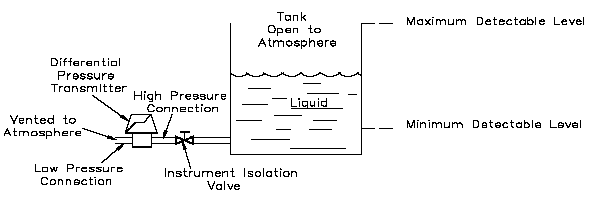
Figure A1
The tank is open to the atmosphere; therefore, it is necessary to use only the high pressure (HP) connection on the DP transmitter. The low pressure (LP) side is vented to the atmosphere; therefore, the pressure differential is the hydrostatic head, or weight, of the liquid in the tank. The maximum level that can be measured by the DP transmitter is determined by the maximum height of liquid above the transmitter. The minimum level that can be measured is determined by the point where the transmitter is connected to the tank.
Not all tanks or vessels are open to the atmosphere. Many are totally enclosed to prevent vapors or steam from escaping, or to allow pressurizing the contents of the tank. When measuring the level in a tank that is pressurized, or the level that can become pressurized by vapor pressure from the liquid, both the high pressure and low pressure sides of the DP transmitter must be connected (Figure A2).

Figure A2
The high pressure connection is connected to the tank at or below the lower range value to be measured. The low pressure side is connected to a "reference leg" that is connected at or above the upper range value to be measured. The reference leg is pressurized by the gas or vapor pressure, but no liquid is permitted to remain in the reference leg. The reference leg must be maintained dry so that there is no liquid head pressure on the low pressure side of the transmitter. The high pressure side is exposed to the hydrostatic head of the liquid plus the gas or vapor pressure exerted on the liquids surface. The gas or vapor pressure is equally applied to the low and high pressure sides. Therefore, the output of the DP transmitter is directly proportional to the hydrostatic head pressure, that is, the level in the tank.
Where the tank contains a condensible fluid, such as steam, a slightly different arrangement is used. In applications with condensible fluids, condensation is greatly increased in the reference leg. To compensate for this effect, the reference leg is filled with the same fluid as the tank. The liquid in the reference leg applies a hydrostatic head to the high pressure side of the transmitter, and the value of this level is constant as long as the reference leg is maintained full. If this pressure remains constant, any change in DP is due to a change on the low pressure side of the transmitter (Figure A3).

Figure A3
The filled reference leg applies a hydrostatic pressure to the high pressure side of the transmitter, which is equal to the maximum level to be measured. The DP transmitter is exposed to equal pressure on the highand low pressure sides when the liquid level is at its maximum; therefore, the differential pressure is zero. As the tank level goes down, the pressure applied to the low pressure side goes down also, and the differential pressure increases. As a result, the differential pressure and the transmitter output are inversely proportional to the tank level.
Link to this Webpage:

© Copyright 2000 -
2024, by Engineers Edge, LLC
www.engineersedge.com
All rights reserved
Disclaimer |
Feedback
Advertising
| Contact


