
Flow Meter Type Detectors Review
Electronics, Instrumentation & Electrical Database
Flow Meter Type Detectors Review
Flow meters operate on the principle of placing a restriction in the line to cause a differential pressure head. The differential pressure, which is caused by the head, is measured and converted to a flow measurement. Industrial applications of flow meters incorporate a pneumatic or electrical transmitting system for remote readout of flow rate. Generally, the indicating instrument extracts the square root of the differential pressure and displays the flow rate on a linear indicator. There are two elements in a flow meter; the primary element is the restriction in the line, and the secondary element is the differential pressure measuring device. Figure F1 shows the basic operating characteristics of a flow meter.

Figure F1
The flow-path restriction, such as an orifice, causes a differential pressure across the orifice. This pressure differential is measured by a mercury manometer or a differential pressure detector. From this measurement, flow rate is determined from known physical laws.
The flow meter actually measures volume flow rate rather than mass flow rate. Mass flow rate is easily calculated or computed from volumetric flow rate by knowing or sensing temperature and/or pressure. Temperature and pressure affect the density of the fluid and, therefore, the mass of fluid flowing past a certain point. If the volumetric flow rate signal is compensated for changes in temperature and/or pressure, a true mass flow rate signal can be obtained. In Thermodynamics it is described that temperature and density are inversely proportional, while pressure and density are directly proportional. To show the relationship between temperature or pressure, the mass flow rate equation is often written as either Equation E-1 or E-2.
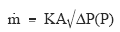 E-1
E-1
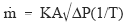 E-2
E-2
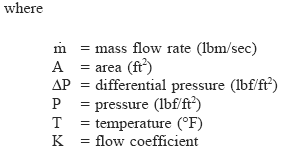
The flow coefficient is constant for the system based mainly on the construction characteristics of the pipe and type of fluid flowing through the pipe. The flow coefficient in each equation contains the appropriate units to balance the equation and provide the proper units for the resulting mass flow rate. The area of the pipe and differential pressure are used to calculate volumetric flow rate. As stated above, this volumetric flow rate is converted to mass flow rate by compensating for system temperature or pressure.
Link to this Webpage:

© Copyright 2000 -
2024, by Engineers Edge, LLC
www.engineersedge.com
All rights reserved
Disclaimer |
Feedback
Advertising
| Contact


