
Synchronous Motor Field Excitation Review
Industrial Electric Motors and Generators Menu
Synchronous Motor Field Excitation Review
A synchronous electric motor is an AC motor in which, at steady state the rotation of the shaft is synchronized with the frequency of the supply current the rotation period is exactly equal to an integral number of AC cycles. Synchronous motors contain electromagnets on the stator of the motor that create a magnetic field which rotates in time with the oscillations of the line current. The rotor with permanent magnets or electromagnets turns in step with the stator field at the same rate and as a result, provides the second synchronized rotating magnet field of any AC motor .
Related Resources
For a constant load, the power factor of a synchronous motor can be varied from a leading value to a lagging value by adjusting the DC field excitation (Figure 1). Field excitation can be adjusted so that PF = 1 (Figure 1a). With a constant load on the motor, when the field excitation is increased, the counter EMF (VG) increases. The result is a change in phase between stator current (I) and terminal voltage (Vt), so that the motor operates at a leading power factor (Figure 1b). Vp in Figure 9 is the voltage drop in the stator winding’s due to the impedance of the windings and is 90o out of phase with the stator current. If we reduce field excitation, the motor will operate at a lagging power factor (Figure 1c). Note that torque angle, a, also varies as field excitation is adjusted to change power factor.
Synchronous motors are used to accommodate large loads and to improve the power factor of transformers in large industrial complexes.
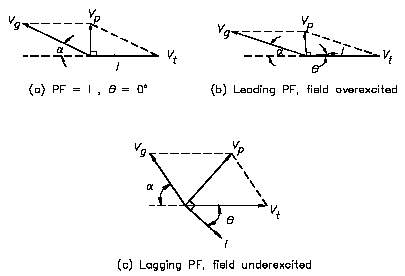
Figure 1
Link to this Webpage:

© Copyright 2000 -
2024, by Engineers Edge, LLC
www.engineersedge.com
All rights reserved
Disclaimer |
Feedback
Advertising
| Contact


