
O-Rings Design Guidelines, Specifications, Materials - Engineers Edge
O-Rings Design Guidelines, Specifications, Materials
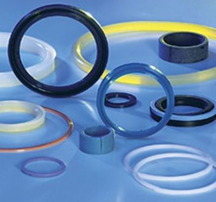
An O-ring , also known as a packing , is a flexible gasket in the shape of a loop; it is a elastomer with a round cross-section designed to be seated in a groove and compressed during assembly between two or more parts, creating a seal at the interface.
The O-ring may be used in static applications or in dynamic applications where there is relative motion between the parts and the O-ring. Dynamic examples include rotating pump shafts and hydraulic cylinder pistons.
O-rings are one of the most common seals used in machine design because they are inexpensive, easy to make, reliable, and have simple mounting requirements.
Related O-Ring Resources:
- O-Ring Installation Design and Specification Static Cylindrical Installations
- O-Ring Installation Design and Specification Static Flange Application
- O-Ring Installation Design and Specification For Dynamic Applications
- O-Ring Leak Rate Equation and Calculator
Design guidelines for O-Rings:
- A stretch greater than 5% on the O-ring I.D. is not recommended because it can lead to a loss of seal compression.
- A Groove depth is the machined depth into one surface, whereas a Gland depth consist of the groove depth plus diametrical clearance and is used to calculate seal compression.
- To create seal compression the groove depth must be less than the seal cross section. To compensate for this compression, the groove width must be greater than the seal cross section.
- Static applications are more tolerant of material and design limitations than dynamic applications.
- The maximum volume of the O-ring should never surpass the minimum volume of the gland.
- For reciprocating seals passing O-rings over ports is not recommended. Nibbling and premature wear and seal failure will result.
- The closer the application is to room temperature, the longer an O-ring can be expected to effectively seal.
- Avoid using graphite-loaded compounds with stainless steel, as they tend to pit the stainless steel surface over time.
- Before installation, make sure the lightly coat the O-ring with a lubricant that is compatible with the O-ring material, as well as with system chemicals.
- When using only one back-up ring, be sure to install it on the low pressure side of the O-ring.
- Static seal cross-sections are generally compressed from 10% to 40%, whereas Dynamic seals are from 10% to only 30%.
- When it is said that an elastomer is good for an application it is meant that some compounds which include that material are acceptable. Not All. For instance, some compounds of EP are good for brake fluid applications, but most are not acceptable.
- Material cost does not correlate with performance, it depends on the application.
- You must test all seals in their actual environment because every application is unique.
- DO NOT use a lubricant composed of the same material as the O-ring. For example, a silicone lubricant should NOT be used with a silicone O-ring.
- Resistance of elastomers to chemical attack is greatly reduced at elevated temperatures.
 |
Typical O-ring Applications:
Successful O-ring joint design requires a rigid mechanical mounting that applies a predictable deformation to the O-ring. This introduces a calculated mechanical stress at the O-ring contacting surfaces. As long as the pressure of the fluid being contained does not exceed the contact stress of the O-ring, leaking cannot occur. Fortunately, the pressure of the contained fluid transfers through the essentially incompressible O-ring material, and the contact stress rises with increasing pressure. For this reason, an O-ring can easily seal high pressure as long as it does not fail mechanically. The most common failure is extrusion through the mating parts.
The seal is designed to have a point contact between the O-ring and sealing faces. This allows a high local stress, able to contain high pressure, without exceeding the yield stress of the O-ring body. The flexible nature of O-ring materials accommodates imperfections in the mounting parts. But it is still important to maintain good surface finish of those mating parts, especially at low temperatures where the seal rubber reaches its glass transition temperature and becomes increasingly crystalline. Surface finish is also especially important in dynamic applications. A surface finish that is too rough will abrade the surface of the O-ring, and a surface that is too smooth will not allow the seal to be adequately lubricated by a fluid film.
O-ring selection is based on chemical compatibility, application temperature, sealing pressure, lubrication requirements, durometer , size and cost.
Synthetic rubbers - Thermosets:
- Butadiene rubber (BR)
- Butyl rubber (IIR)
- Chlorosulfonated polyethylene (CSM)
- Epichlorohydrin rubber(ECH, ECO)
- Ethylene propylene diene monomer (EPDM): good resistance to hot water and steam, detergents, caustic potash solutions, sodium hydroxide solutions, silicone oils and greases, many polar solvents and many diluted acids and chemicals. Special formulations are excellent for use with glycol-based brake fluids. Unsuitable for use with mineral oil products: lubricants, oils, or fuels. Peroxide-cured compounds are suitable for higher temperatures.
- Ethylene propylene rubber (EPR)
- Fluoroelastomer (FKM): noted for their very high resistance to heat and a wide variety of chemicals. Other key benefits include excellent resistance to aging and ozone, very low gas permeability and the fact that the materials are self-extinguishing. Standard FKM materials have excellent resistance to mineral oils and greases, aliphatic, aromatic and chlorinated hydrocarbons, fuels, non-flammable hydraulic fluids (HFD) and many organic solvents and chemicals. Generally not resistant to hot water, steam, polar solvents, glycol-based brake fluids and low molecular weight organic acids. In addition to the standard FKM materials, a number of specialty materials with different monomer compositions and fluorine content (65% to 71%) are available that offer improved chemical or temperature resistance and/or better low temperature performance.
- Nitrile rubber (NBR, HNBR, HSN): a common material for o-rings because of its good mechanical properties, its resistance to lubricants and greases, and its relatively low cost. The physical and chemical resistance properties of NBR materials are determined by the acrylonitrile (ACN) content of the base polymer: low content ensures good flexibility at low temperatures, but offers limited resistance to oils and fuels. As the ACN content increases, the low temperature flexibility reduces and the resistance to oils and fuels improves. Physical and chemical resistance properties of NBR materials are also affected by the cure system of the polymer. Peroxide-cured materials have improved physical properties, chemical resistance and thermal properties, as compared to sulfur-donor-cured materials. Standard grades of NBR are typically resistant to mineral oil-based lubricants and greases, many grades of hydraulic fluids, aliphatic hydrocarbons, silicone oils and greases and water to about 80 °°C. NBR is generally not resistant to aromatic and chlorinated hydrocarbons, fuels with a high aromatic content, polar solvents, glycol-based brake fluids and non-flammable hydraulic fluids (HFD). NBR also has low resistance to ozone, weathering and aging. HNBR has considerable improvement of the resistance to heat, ozone and aging, and gives it good mechanical properties.
- Perfluoroelastomer (FFKM)
- Polyacrylate rubber (ACM)
- Polychloroprene ( neoprene ) (CR)
- Polyisoprene (IR)
- Polysulfide rubber (PSR)
- Polytetrafluoroethylene (PTFE)
- Sanifluor
- Silicone rubber (SiR): noted for their ability to be used over a wide temperature range and for excellent resistance to ozone, weathering and aging. Compared with most other sealing elastomers, the physical properties of silicones are poor. Generally, silicone materials are physiologically harmless so they are commonly used by the food and drug industries. Standard silicones are resistant to water (to 100 °C), aliphatic engine and transmission oils and animal and plant oils and fats. Silicones are generally not resistant to fuels, aromatic mineral oils, steam (short term to 120 °C is possible), silicone oils and greases, acids or alkalis. Fluorosilicone elastomers are far more resistant to oils and fuels. The temperature range of applications is somewhat more restricted.
- Styrene butadiene rubber (SBR)
Thermoplastics :
- Thermoplastic elastomer (TPE) styrenics
- Thermoplastic polyolefin (TPO) LDPE, HDPE, LLDPE, ULDPE
- Thermoplastic polyurethane (TPU) polyether , polyester : Polyurethanes differ from classic elastomers in that they have much better mechanical properties. In particular they have a high resistance to abrasion, wear and extrusion, a high tensile strength and excellent tear resistance. Polyurethanes are generally resistant to aging and ozone, mineral oils and greases, silicone oils and greases, nonflammable hydraulic fluids HFA & HFB, water up to 50 °C and aliphatic hydrocarbons.
- Thermoplastic etheresterelastomers (TEEEs) copolyesters
- Thermoplastic polyamide (PEBA) Polyamides
- Melt Processible Rubber (MPR)
- Thermoplastic Vulcanizate (TPV)
Chemical Compatibility :
- Air, 200 - 300 °F °? Silicone
- Beer - EPDM
- Chlorine Water °? Viton (FKM)
- Gasoline °? Buna-N or Viton (FKM)
- Hydraulic Oil (Petroleum Base, Industrial) °? Buna-N
- Hydraulic Oils (Synthetic Base) °? Viton
- Water °? EPDM
- Motor Oils °? Buna-N
Link to this Webpage:

© Copyright 2000 -
2024, by Engineers Edge, LLC
www.engineersedge.com
All rights reserved
Disclaimer |
Feedback
Advertising
| Contact


