
Ideal Pinned Column Buckling Equation and Calculation, Euler's Formula
For the ideal pinned column shown in below, the critical buckling load can be calculated using Euler's formula:

Open: Ideal Pinned Column Buckling Calculator
Where:
E = Modulus of elasticity of the material
I = Minimum moment of inertia
L = Unsupported length of the column (see picture below)
Note that regardless of the end condition, the critical load depends not on the material strength, but rather the flexural rigidity, EI. Buckling resistance can be increased by increasing the moment of inertia.
When a column buckles, it maintains its deflected shape after the application of the critical load. In most applications, the critical load is usually regarded as the maximum load sustainable by the column. Theoretically, any buckling mode is possible, but the column will ordinarily deflect into the first mode. A column will buckle when the load P reaches a critical level, called the critical load, Pcr.
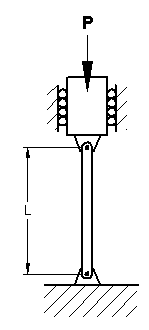
Ideal Pinned Column (Pinned - Pinned)
For columns with different types of support, Euler's formula may still be used if the distance L is replaced with the distance between the zero moment points. See "Effective Length Constant Table" below.
This length is called the effective length Le and is illustrated in below. Thus the critical load equation becomes:

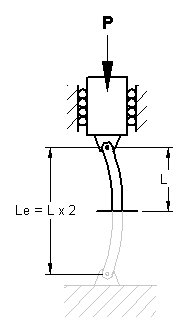
The slenderness ratio is an important parameter in the classification of compression members, and is represented by the equation:


Where:
r = Radius of gyration
I = Moment of inertia
A = Area cross section
If the slenderness ratio > (greater than) critical slenderness ratio, then the column is treated as a long column and the Euler buckling formula is applicable.
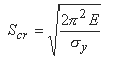
If slenderness ratio is < (less than) the critical slenderness ratio, the column is treated as a short column.
In short columns, failure may occur by compression without significant buckling and at stresses exceeding the proportional limit. For this condition, Johnson's formula is applicable:
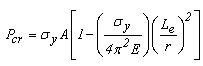
For columns that fail subsequent to the onset of inelastic behavior, the constant of proportionality must be used rather than the modulus of elasticity (Engesser formula). The constant of proportionality, Et, is the slope of the stress-strain diagram beyond the proportional limit, termed the tangent modulus. Note within the linearly elastic range, E = Et.
| Effective Length Constant Table | |
| Column Boundary | Effective Length Constant ** C = Le / L |
| Free - Free | 1.0 |
| Fixed - Free | 2.0 |
| Fixed - Pinned | .707 |
| Fixed - Guided | 1.0 |
| Fixed - Fixed | .5 |
| Guide - Free | 2.0 |
| Guided - Pinned | 2.0 |
| Guided - Guided | 1.0 |
| Pinned - Free | 1.0 |
| Pinned - Pinned | 1.0 |
** In practice, the Effective Length Constant is increased by a factor approximately 10 - 20 %
Open: Ideal Pinned Column Buckling Calculator
Related
- Ideal Pinned Column Buckling Equation and Calculation, Euler's Formula
- Buckling of Cylinder Plate Equations and Calculation
- Rankine Gordon Equation
- Buckling of a rectangular column on the basis of Murnaghan's formula for strain energy
- Beam Spring Fixed Ends with Concentrated Mass Loads Angular Natural Frequency Equations and Calculator
- Beam Fixed End and Cantilevered Angular Natural Frequency Equations and Calculator
- Beam Simple Hinged-Hinged Ends Angular Natural Frequency Equations and Calculator
- Beam with Fixed-Fixed Ends Angular Natural Frequency Equations and Calculator
- Beam with one End Free and Other Fixed Angular Natural Frequency Equations and Calculator
- Beam with one End Free and Other Hinged Angular Natural Frequency Equations and Calculator
- Thin Flat Plates of Uniform Thickness Natural Frequency Equations and Calculator
Link to this Webpage:

© Copyright 2000 -
2024, by Engineers Edge, LLC
www.engineersedge.com
All rights reserved
Disclaimer |
Feedback
Advertising
| Contact


